Jubilee Year of St. Francis of Assisi
“In commemorating the significant anniversary of the eighth centenary of his passing, I wish to join spiritually with the entire Franciscan Family and with all those who will take part in the commemorative events, hoping that the message of peace may find a profound echo in the Church and society today.”
(Letter from Pope Leo XIV for the Jubilee 2026, Jan. 7, 2026)
Jan. 10, 2026 – Jan. 10, 2027
The Jubilee Year
“In this age, marked by so many seemingly interminable wars, by internal and social divisions…The Franciscan vision of peace is not limited to the relations between human beings, but also embraces the whole of creation. Francis, who calls the sun “brother” and the moon “sister”, who recognizes in every creature a reflection of divine beauty, reminds us that peace must be extended to the entire family of Creation.”
Letter from Pope Leo XIV for the Jubilee 2026, Jan. 7, 2026)
Biography
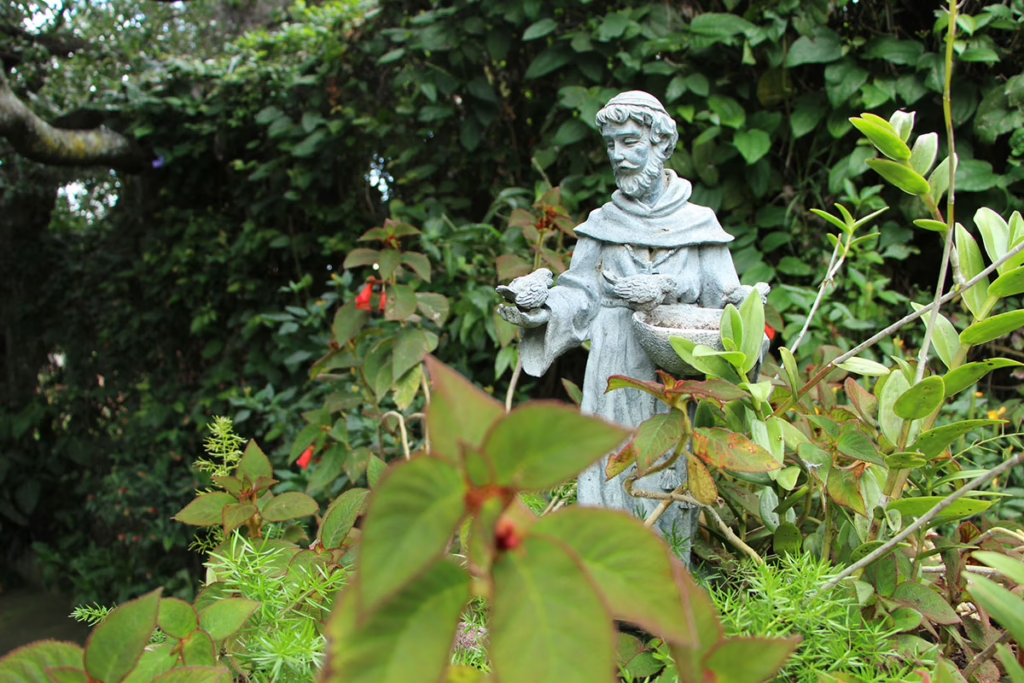
St. Francis of Assisi was a beloved Catholic saint known for radical humility, deep love for Christ, and joyful poverty. Born wealthy in Assisi, Italy, he experienced a profound spiritual conversion after illness, feeling called by God to abandon worldly ambition and “rebuild” the Church through a life of simplicity and Gospel witness. He founded the Franciscans, emphasizing poverty, fraternity, service to the poor, and reverence for all creations, earning him recognition as patron saint of ecology. Devoted to the Eucharist and Christ’s Passion, he received the stigmata near the end of his life. Canonized shortly after his death, he remains a powerful model of humility, peace, and inner transformation.
Indulgence
In its decree, the Apostolic Penitentiary announced that plenary indulgences will be granted to Catholics “under the usual conditions (sacramental confession, Eucharistic communion and prayer for the intentions of the Holy Father), which can also be applied in the form of suffrage for the souls in Purgatory.” The indulgence will be granted to those who participate in a pilgrimage “to any Franciscan conventual church, or place of worship in any part of the world named after St. Francis or connected to him for any reason,” it stated. (See the list of parishes in our diocese.) The sick, the elderly and caretakers unable to leave their homes can also obtain a plenary indulgence under the usual conditions “if they join spiritually in the Jubilee celebrations of the Year of St. Francis, offering their prayers to the Merciful God, the pains or sufferings of one’s life.” – Junno Arocho Esteves, OSV News.
- An indulgence is a remission of temporal punishment (forgivable, unlike eternal, punishment) a person is due for their sins already forgiven in confession, according to the Catechism of the Catholic Church (1471).
- “Every sin ‘leaves its mark’” even after a person has received forgiveness and absolution through the sacrament of reconciliation, Pope Francis wrote in the document proclaiming the Jubilee Year. “Sin has consequences, not only outwardly in the effects of the wrong we do, but also inwardly, since ‘every sin, even venial, entails an unhealthy attachment to creatures, which must be purified either here on earth, or after death, in the state called Purgatory,’” he wrote, quoting the Catechism. (Read more)
- The purpose of indulgences is not to discard sins, but rather to address the consequences of sin while reducing one’s time spent in Purgatory. You can gain indulgences for yourself or apply them to the souls in Purgatory.
- There are two types of indulgences:
- Partial indulgence: Removes part of the temporal punishment.
- Plenary (or full) indulgence: Removes all temporal punishment.
- Be in a state of grace (free from mortal sin).
- Perform the prescribed work (such as prayers, a pilgrimage or a charitable act).
- Fulfill these conditions:
- Go to confession within 20 days before or after the prescribed work.
- Receive Holy Communion, preferably on the day of the visit, or 20 days before/after the visit.
- Pray for the intentions of the pope (often an Our Father, Apostles’ Creed, and other prayer).
- Be detached from sin, even venial sin (to have a sincere heart that doesn’t cling to any kind of sin, even small ones). It’s about truly wanting to avoid sin and grow closer to God.
- Indulgences can be applied either to yourself or to the souls of the deceased, but they cannot be applied to other people still living.
Prayers to St. Francis
Peace
Small yellow Cross
Lord, make me an instrument of your peace.
Where there is hatred, let me sow love;
where there is injury, pardon;
where there is doubt, faith;
where there is despair, hope;
where there is darkness, light;
where there is sadness, joy.
O Divine Master,
grant that I may not so much seek to be consoled, as to console;
to be understood, as to understand;
to be loved, as to love with all my soul.
For it is in giving that we receive;
it is in pardoning that we are pardoned;
and it is in dying that we are born to eternal life. Amen.